
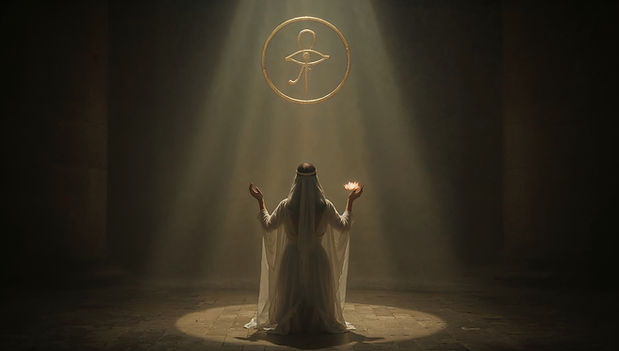
Worship and Devotion
"Living in the presence of the Gods, transforming life into a sacred offering"
The cult of the Egyptian deities permeated every aspect of ancient Egyptian life, from agriculture to warfare, from birth to death. In temples and tombs, priests and devotees honored the Gods with prayers, offerings, and sacred rituals, seeking to gain their favor and protection.
Worship and Devotion in Ancient Egypt
In the world of Kemet, worship was not an occasional act, but a form of existence. Every dawn, every harvest, every birth and death were immersed in the sacredness of the cosmos. The Egyptians did not separate the divine from the everyday: the entire universe was a temple, and living meant participating in the ordered dance of Maat, universal harmony.
In the great stone temples, built as reflections of the sky on Earth, priests officiated rituals of light and breath. At dawn, they opened the doors of the sanctuary to "awaken the God," pronouncing secret formulas and intoning hymns of praise. The sacred statue, hidden in the Naos (the heart of the temple), was purified with Nile water, anointed with sacred oils, and re-covered with new fabrics.
Every gesture, performed in silence and ritual precision, served to maintain the connection between the human world and the divine. Offering was the language of devotion: bread, beer, lotus flowers, incense, and gold were placed before the images of the Gods. It was not the material gift that mattered, but the energy of the heart, the devotee's Ka uniting with that of the divinity. In this way, the act of giving became a cycle: man nourished the Gods, and the Gods nourished the soul of man.
Even in homes, domestic shrines housed images of Bastet, Hathor, or Osiris. Families lit oil lamps and recited prayers, asking for protection, health, and prosperity. Every home was a small temple, every heart an altar.
During great religious festivals, the people joined the priests in solemn processions. The divine statues were carried on sacred boats along the Nile or through the streets, covered in garlands and golden drapes. Music, chants, and the beating of Hathor's sistrums filled the air, while the people danced in honor of the gods. Worship became a celebration of life itself, a way to unite body and spirit in a single vibration of joy.
Priests lived as intermediaries, purifying themselves daily with ablutions, fasting, and recitations of the Sacred Texts. They did not "serve" the Gods as servants, but as guardians of cosmic balance: every formula spoken, every fire lit, contributed to keeping creation alive. If the rituals ceased, the order of Maat could dissolve, and Chaos—Isfet—would threaten the world.
Devotion was not confined to religion, but permeated art, science, medicine, and love. Writing a hieroglyph, cultivating the land, playing a harp, or building a pyramid were all acts of faith and awareness. The entire population lived under the gaze of the deities, not with fear, but with gratitude: knowing that the Nile flowed because Hapi was propitious, that the Sun rose because Ra conquered the waters of Nun every night.
In the Kemet cult, there was no distance between God and man: the faithful offered their voice, their breath, their inner light. Every being was part of the same cosmic body—a lesser Ka that reflected the Ka of the cosmos.
Rediscovering Egyptian Devotion Today
Reliving ancient worship does not mean imitating a bygone rite, but remembering the sacredness of the gesture. Lighting a candle before an image of Isis, offering flowers to the Sun, or pronouncing the name of Thoth with respect and awareness are acts that rekindle the ancient bond.
True devotion does not require stone temples: it requires an open heart, pure breath, and a luminous intention. In the modern path of the Temple of Kemet, every offering is a vibration, every word an invocation. When your mind is silent and your voice pronounces the divine name, worship comes alive again, and the presence of the Gods becomes perceptible again, not in the distant heavens, but within you.