
Seth
God of storms, of indomitable strength, and of change. Seth is not evil, but the power necessary for transformation. He destroys only the weak, to give birth to the new. Those who understand his fury discover the path to inner mastery.
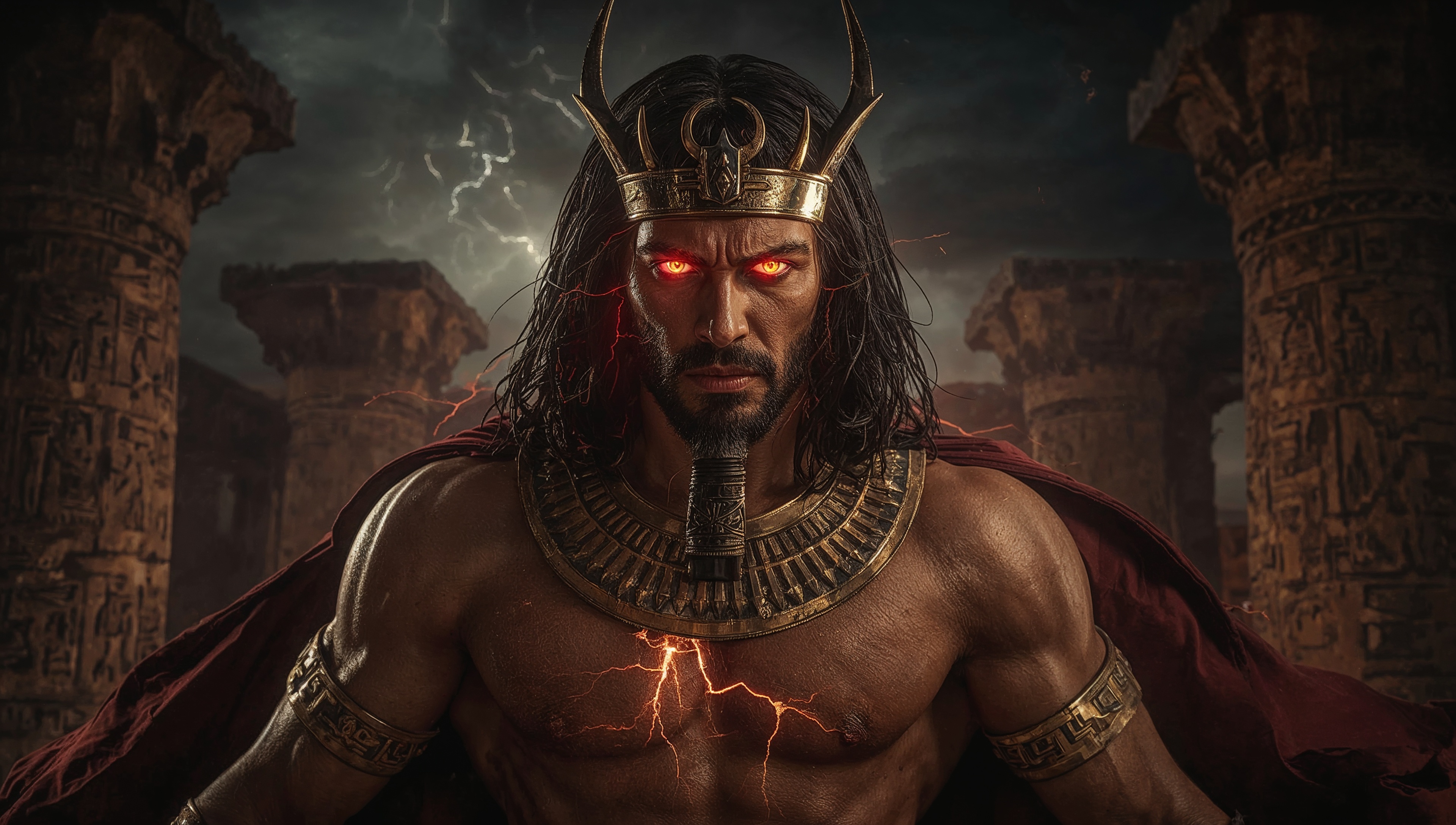
Seth is the primordial force that stirs inertia and challenges the light.
He is the storm necessary for rebirth, the destroyer of illusion, the one who teaches the power of will and self-mastery.
Seth, also known as Sutekh or Setesh, is one of the most complex and misunderstood figures of Egyptian mythology.
He represents the dynamic principle of chaos and the untamed energies that move creation.
He is the brother of Osiris, Isis, and Nephthys, and in the great divine drama he becomes both adversary and catalyst of evolution.
Seth is also the husband of Nephthys.
Though married, their union was not harmonious — Nephthys bore a son, Anubis, from her union with Osiris, an event that awakened Seth’s jealousy.
When Seth kills Osiris, he does not commit a mere act of violence — he initiates the process of cosmic regeneration.
He is the force that breaks static balance so that a purer light may arise.
In the most ancient theology, Seth was not evil, but the guardian of the threshold, the protector of the Sun during its nightly journey, the one who defended Ra from the serpent Apep.
In the desert, his domain, Seth embodies solitude and the initiatory trial.
He is the inner fire that burns away impurities, the voice that drives you beyond your limits and compels you to know yourself.
Those who succeed in integrating him become whole beings — masters of their own shadows, free within their own strength.