
Khnum
An ancient ram-horned god, Khnum shapes life on the sacred potter's wheel of the Nile. He shapes the body and destiny, infusing it with divine breath. He is the creative power that transforms intention into manifestation.
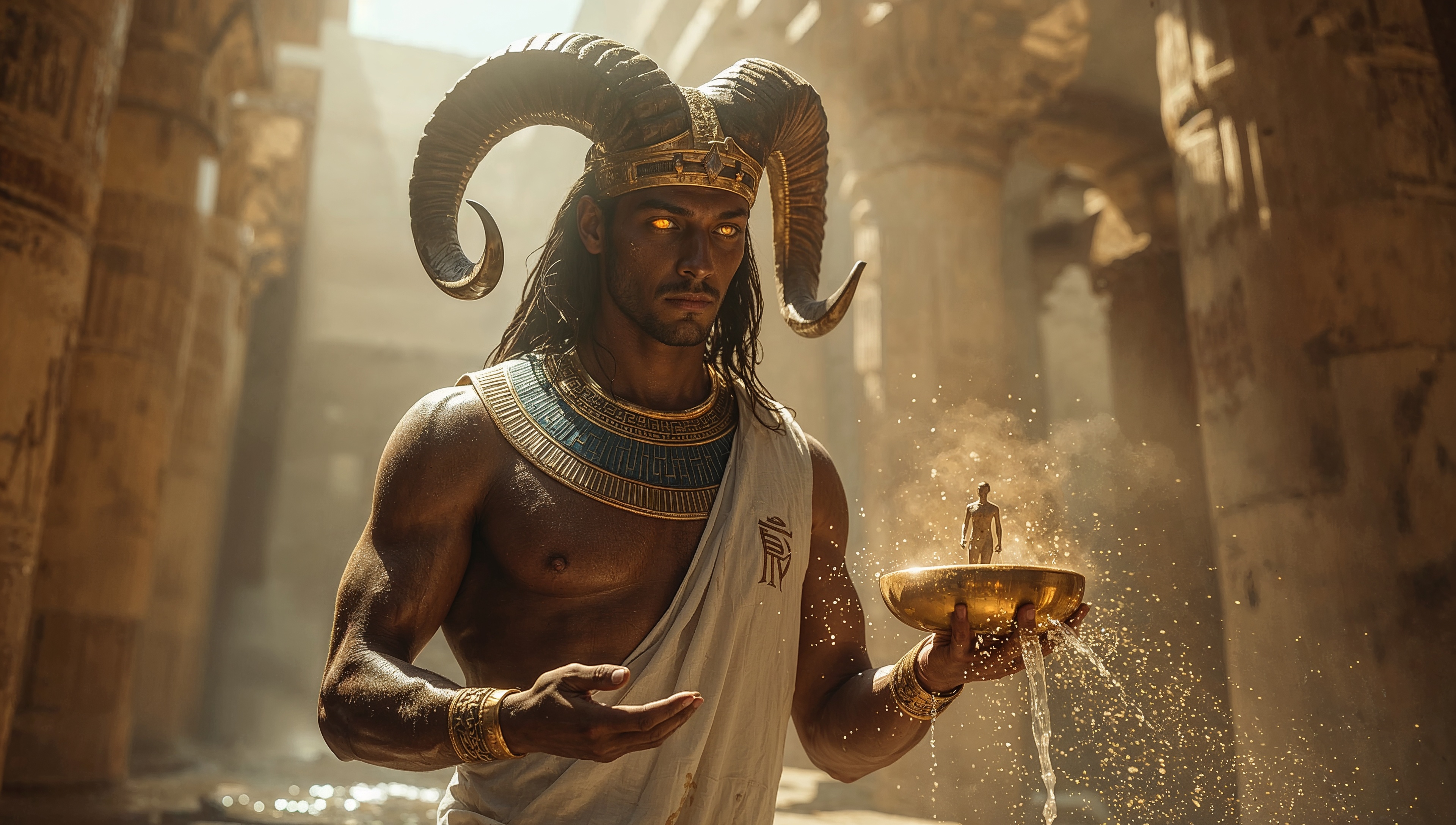
Khnum is the Divine Potter who shapes the bodies of gods and men upon his sacred wheel, using the clay of the Nile and the water of life.
From him comes form, and from his breath arises the soul.
The name Khnum derives from the verb ẖnm, meaning “to unite, to mold, to fashion.”
He was venerated as the demiurgic craftsman, the one who creates life from the primordial waters and gives it form through the potter’s wheel.
Khnum is depicted as a man with the head of a ram, symbol of creative power and fertility.
He sits beside his wheel, molding the bodies of gods and humans, often accompanied by Heket, the frog goddess of birth, who breathes life into the nostrils of the newly formed beings.
In ancient Egypt, it was believed that every person was shaped by Khnum in the mother’s womb.
He gave both physical form and destiny, merging matter and spirit in a single creative act.
His sacred workshop lies symbolically at the source of the Nile, where the river emerges from the subterranean waters — the fountain of all life.
On a cosmic level, Khnum is the ordering principle, the one who transforms chaos into harmony, matter into consciousness.
He works in silence, like a celestial artist, and his wheel is the symbol of the cyclical motion of creation.
In many temple traditions, Khnum was seen as an aspect of Ptah, the creator through the Word; yet while Ptah conceives, Khnum manifests:
Ptah thinks — Khnum shapes.