
Khepri
God of the scarab, symbol of becoming and daily rebirth. Khepri pushes the sun beyond the horizon, renewing creation. He represents the eternal cycle of spiritual transformation.
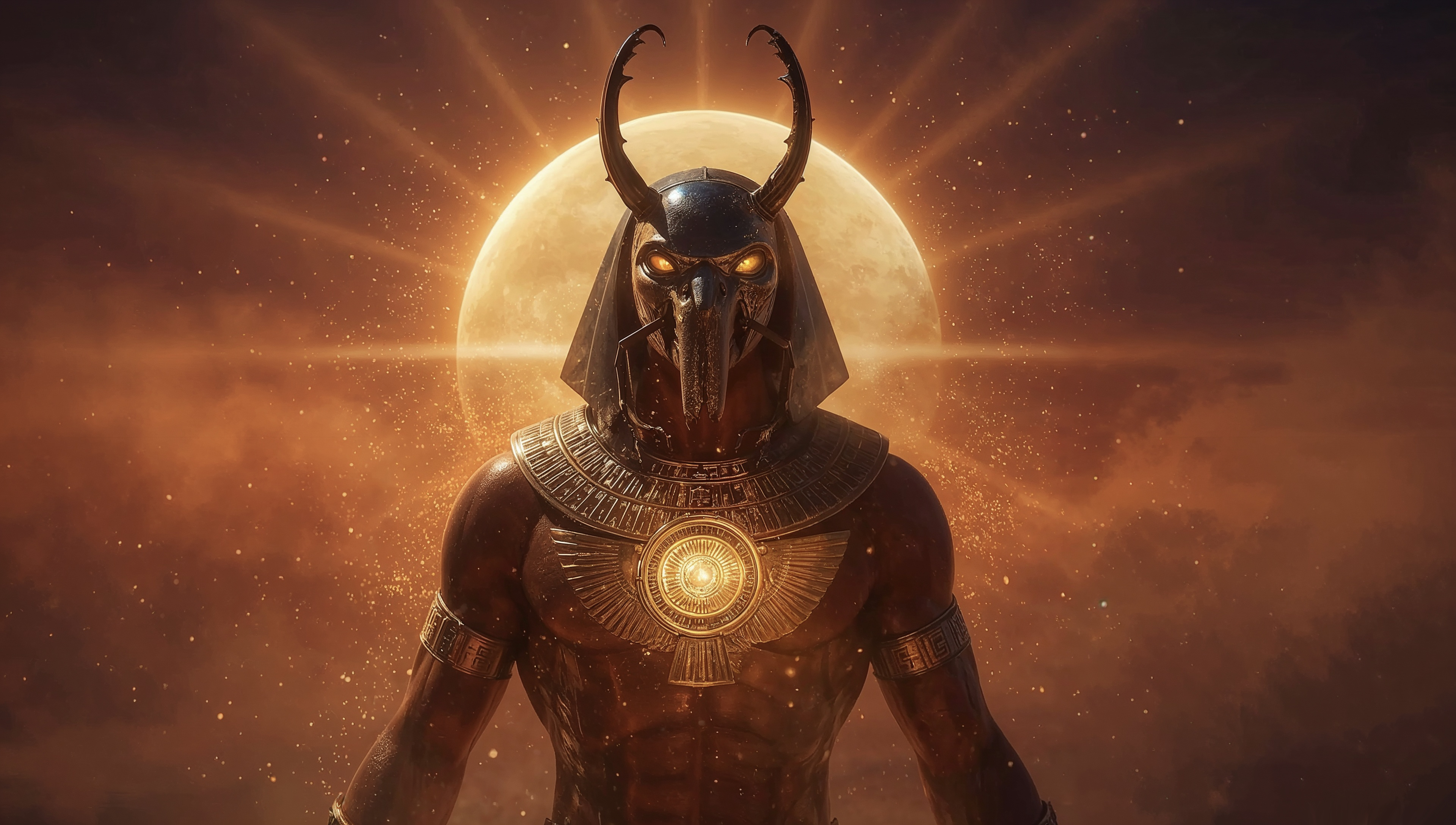
Khepri is the morning form of the solar god Ra.
He represents the cycle of rebirth and the divine power that transforms night into day.
He is the symbol of the soul’s perpetual becoming and of the ability to regenerate through light.
The name Khepri derives from the Egyptian verb ḫpr, meaning “to become,” “to transform,” “to come into a new form.”
He is the force of the Sun at dawn, the vital impulse that makes the day arise and renews creation.
Khepri is depicted as a sacred scarab beetle (Scarabaeus sacer), or as a man with the head of a scarab, pushing the solar disk across the sky, just as the dung beetle rolls its ball of earth — a symbol of the Sun — along the sands of the desert.
This image holds one of the deepest teachings of ancient Egypt:
life is a continuous act of self-generation, of movement and of light.
While Ra represents the Sun in its full glory, and Atum the Sun at sunset, Khepri is the beginning, the renewal, the hope.
He is the moment when the world is reborn, and the soul awakens from the night of unawareness.
In the solar cult, Khepri is also a symbol of the soul’s transformation after death:
he pushes the Sun’s barque through the Duat (the underworld) and brings it forth again at dawn.
For this reason, he was often depicted on sarcophagi and mummies, placed above the heart as an amulet of resurrection.
His power is that of spiritual metamorphosis — the act of rising from one’s own ashes, of bringing light where there was darkness, and of remembering the divine nature within after the oblivion of matter.